





Observability in Banking
From Monitoring to Resilient, Secure Banking Operations A Single Source of Truth for Modern Banking Infrastructure
Banking infrastructure has evolved into a highly interconnected ecosystem of digital platforms, physical systems, and distributed services.
Modern banks rely on:
- digital banking platforms and mobile applications
- core banking systems
- cloud infrastructure and APIs
- payment processing networks
- branch systems
- ATM networks operating across wide geographic regions
Each of these components generates telemetry, alerts, and operational signals.
But as this environment expands, a critical challenge emerges:
How do banks turn this data into fast, coordinated, and intelligent action?
The New Reality: Operational + Security Complexity
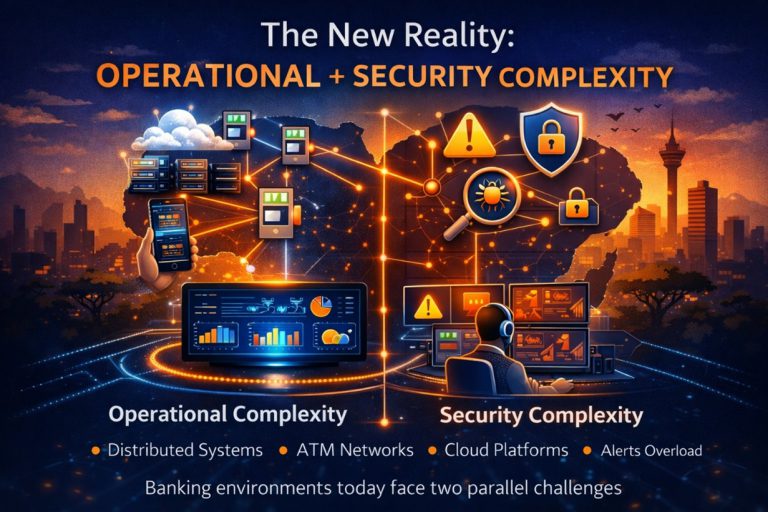
Banking environments today face two parallel challenges:
- Operational Complexity
Highly distributed systems generating massive volumes of telemetry
- Security Risk
Increasing cyber threats targeting credentials, transactions, endpoints, and infrastructure
Traditionally, these have been managed separately:
- IT monitoring tools for performance and availability
• security tools for threat detection and response
But in reality, operational issues and security events are often closely linked.
A performance anomaly may indicate a system failure — or a security breach.
A spike in traffic could be legitimate — or malicious.
Without a unified view, teams are forced to investigate these signals in isolation.
ATM Networks: Where Digital, Physical, and Security Converge
ATM networks are one of the clearest examples of this convergence.
Each ATM represents a distributed operational endpoint that includes:
- transaction processing systems
- embedded operating systems
- network connectivity
- hardware components
- physical access points
- environmental conditions
From an observability perspective, ATMs generate telemetry across:
- performance and availability
- hardware health
- connectivity
- environmental conditions
From a security perspective, they are also potential targets for:
- credential attacks
- physical tampering
- malware injection
- network intrusion
Observability platforms that ingest both operational and security signals provide a far more complete view of ATM network health and risk.
A Single Source of Truth
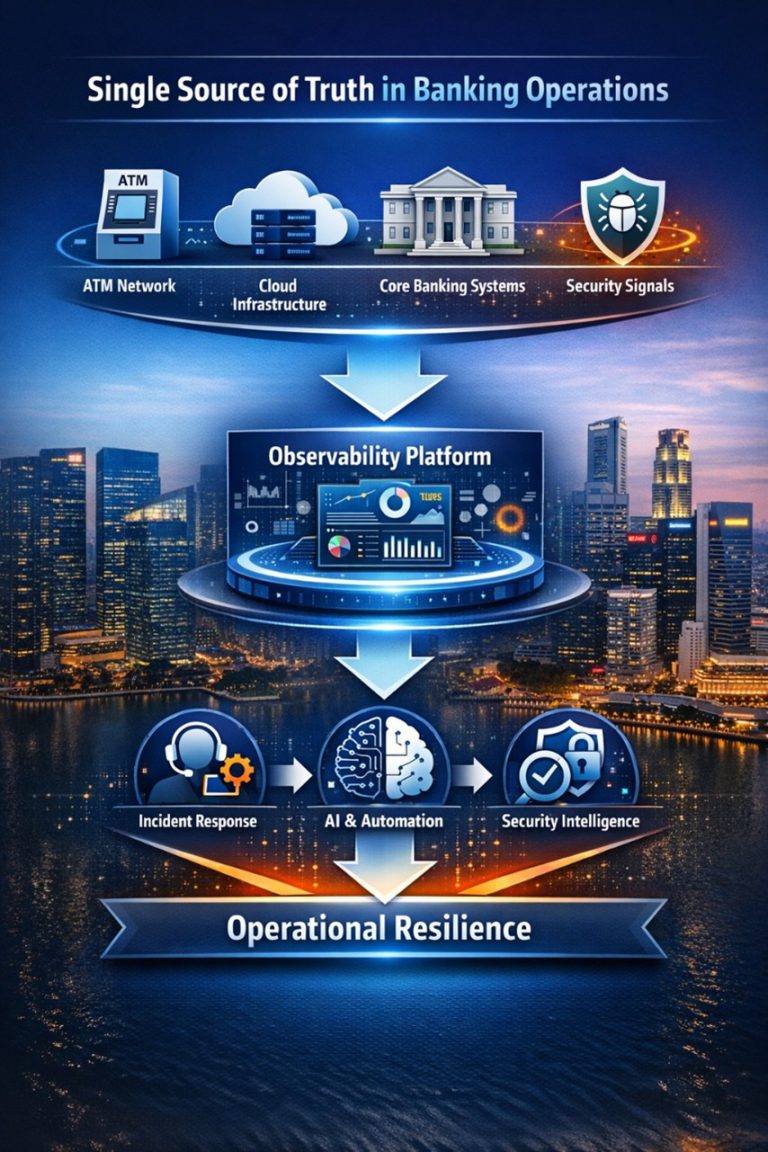
One of the most important shifts in modern banking operations is the move toward a single source of truth.
Instead of multiple disconnected monitoring and security tools, observability platforms can aggregate:
- infrastructure telemetry
- application performance data
- cloud workload signals
- IoT and ATM telemetry
- security alerts and events
This unified data model allows banks to:
- correlate operational and security events
- identify root cause faster
- reduce investigation time
- eliminate blind spots across systems
In practice, this means teams are no longer asking:
“Is this a performance issue or a security issue?”
They are able to see both perspectives in one place.
Reducing MTTA and MTTR
Speed is critical in banking operations.
Two metrics matter most:
- MTTA (Mean Time to Acknowledge)
- MTTR (Mean Time to Resolve)
Observability and unified incident response platforms improve both significantly.
Faster MTTA
Through:
- intelligent alert correlation
• prioritisation of high-impact incidents
• automated on-call routing
The right teams are notified immediately, reducing delays in response.
Faster MTTR
Through:
- unified incident views with full context
- correlation across systems
- real-time collaboration tools
- automated workflows
Teams can move quickly from detection to resolution.
From Detection to Prediction and Remediation
Modern observability platforms are not limited to detecting incidents.
They are increasingly capable of:
Predicting Issues
Using AI-driven analysis to detect:
- performance degradation patterns
- abnormal transaction behaviour
- infrastructure anomalies
- early hardware failure signals
Automating Remediation
Triggering actions such as:
- restarting services
- scaling cloud infrastructure
- rerouting network traffic
- isolating affected systems
This shifts operations from:
reactive → proactive → predictive
Cybersecurity Visibility Within Observability
One of the most powerful capabilities emerging in observability platforms is the integration of security visibility into operational workflows.
This allows banks to:
- detect unusual access patterns
- identify anomalous behaviour across systems
- correlate security alerts with operational impact
- track incidents across both IT and security domains
For example:
- A spike in ATM transaction failures could correlate with a network anomaly or security event
- Unusual system behaviour could indicate credential compromise or unauthorised access
- Infrastructure performance issues may be linked to malicious activity
By bringing security signals into observability platforms, banks gain:
contextual security intelligence, not just isolated alerts.
The African Context: Scale, Distribution, and Opportunity
Across Africa, banking infrastructure presents a unique operational landscape.
ATM networks are often widely distributed across urban centres, townships, and remote regions, where connectivity, power stability, and environmental conditions can vary significantly.
At the same time, digital banking adoption is accelerating rapidly, with mobile-first platforms becoming the primary interface for millions of users.
This creates a hybrid environment where:
- physical banking infrastructure (ATMs and branches)
- digital banking platforms
- cloud services
- mobile ecosystems
must operate seamlessly together.
In this context, observability becomes even more critical.
Banks require real-time visibility not only into system performance, but also into:
- connectivity reliability across regions
- infrastructure constraints and outages
- environmental impacts on physical systems
- emerging cybersecurity threats
A unified observability platform — acting as a single source of truth — enables banks to:
- reduce downtime across distributed networks
- improve service delivery in underserved or remote areas
- respond faster to both operational and security incidents
- scale digital banking services with confidence
For organisations and partners operating across Africa, this represents a significant opportunity to build resilient, scalable, and intelligent banking systems that are designed for the realities of the continent.
The Bigger Shift: Intelligent, Resilient Banking Operations
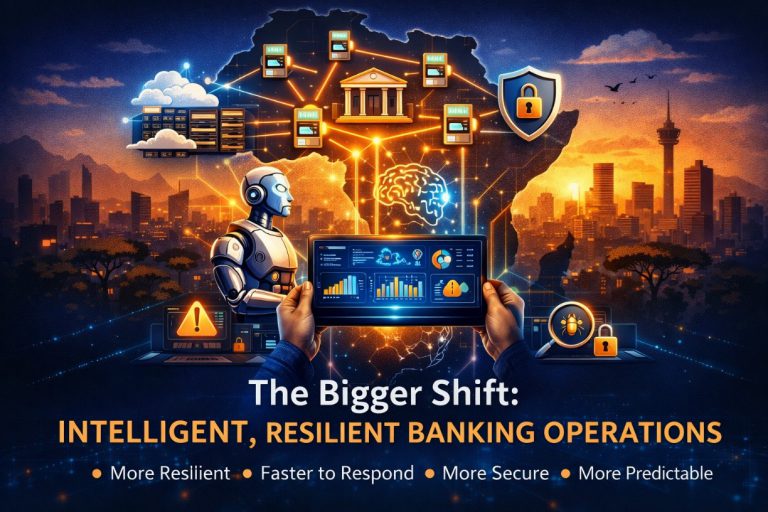
When banks combine:
- observability across infrastructure, cloud, and ATM networks
- unified incident response workflows
- AI-driven analytics
- integrated security visibility
they begin to build environments that are:
- more resilient
- aster to respond
- more secure
- more predictable
This is no longer just monitoring.
It is operational and security intelligence combined.
A Final Thought
Banking has always been built on trust.
Today, that trust depends on the reliability and security of digital systems.
Observability platforms are evolving from tools that monitor infrastructure into platforms that provide a single, intelligent view of operations and security.
The banks that embrace this approach will not only reduce downtime and improve response times.
They will build environments that can anticipate risk, respond faster, and protect both systems and customers more effectively.
Glenn Lazarus
CEO | ATS Network Management